Bachelor’s capstone · Conversational AI
Multilingual conversational agent
Connecting a recurrent text model, dialogue logic, and a multilingual messaging interface.
A Telegram-based conversational prototype combining sentiment analysis, rule-based dialogue, and translation support for multilingual interaction.
Capstone team member · Conversational interface and model/API integration
July 2021 – May 2022
Team research prototype
Prototype interface · translation support across 109 languages; demonstrations in Hindi and Punjabi.
01 / CONTEXT & CONTRIBUTION
Multilingual Conversational Agent for Depression Detection
For our bachelor’s capstone, we explored a multilingual conversational interface that used sentiment signals to select dialogue branches. Telegram handled messaging, with translation connecting language input and output.
Our focus was connecting a recurrent text model to a working conversational system. We developed it as a sentiment-driven research prototype.
My role in the work
- I worked on the rule-based conversational interface and its integration with a recurrent sentiment-analysis model.
- I integrated the conversational workflow with Telegram and Google translation tools.
- I developed the project with a four-person capstone team under Dr. Rajeev Kumar.
Team: Aditi Katoch, Uttkarsh Chaurasia, Mayank Mongia, Yarra Sai Prasanth
Advisor: Dr. Rajeev Kumar
02 / METHOD & SYSTEM
Connecting a model to a conversation.
01Prepare text for a recurrent model
We built a vocabulary with Gensim, mapped words to vocabulary indices, and split or zero-padded text into 20-word inputs. With limited compute, we trained on a subset of roughly a thousand tweets.
02Produce a sentiment signal
We used a Keras/LSTM pipeline for binary sentiment prediction during development and a Bi-LSTM model in the final system.
03Route a scripted conversation
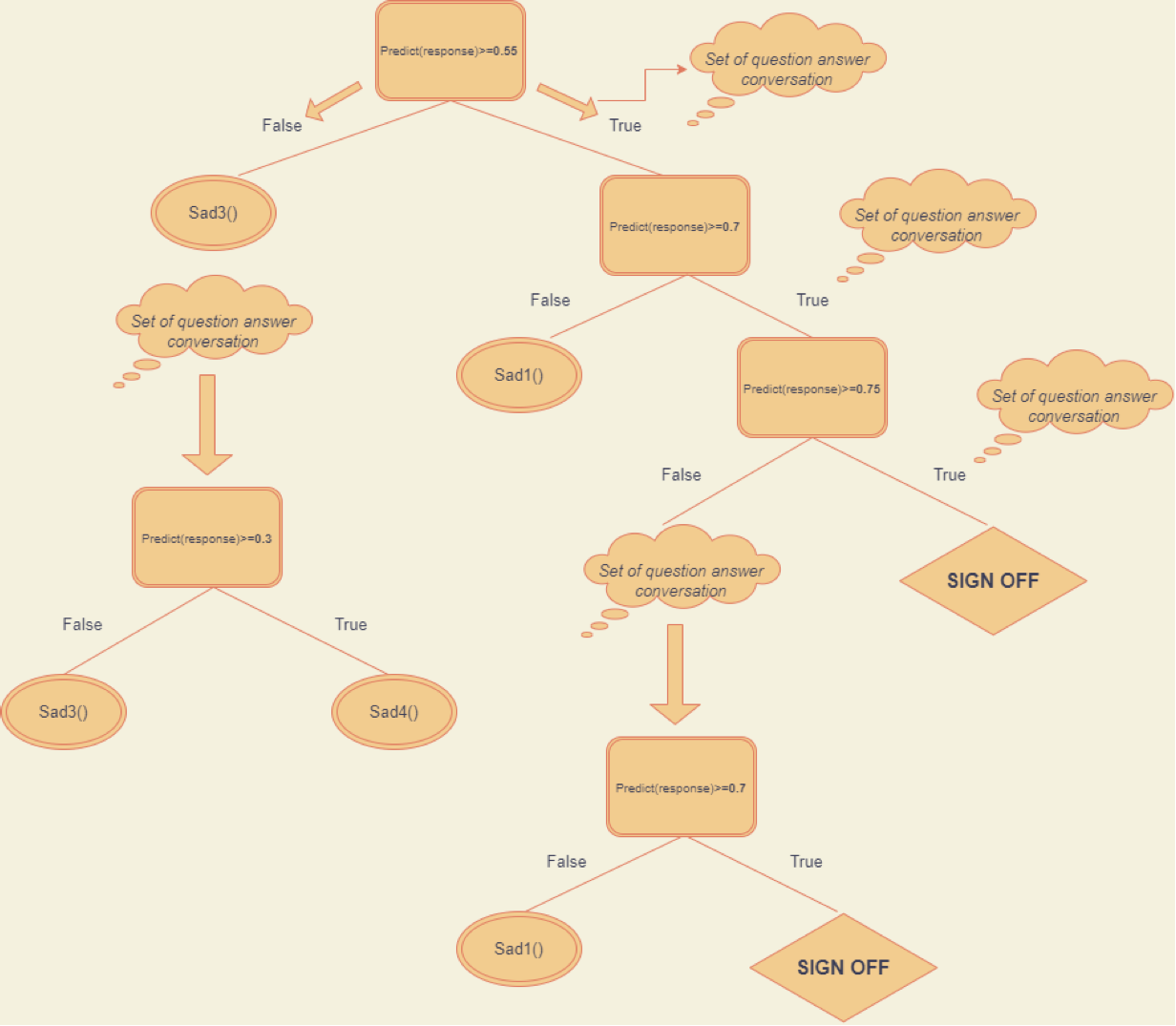
Python functions and a tree-like rule structure use model-score thresholds to choose follow-up questions and responses.
04Connect messaging and translation
We connected the Telegram API, PythonAnywhere hosting, and Google translation support, demonstrating conversations in Hindi and Punjabi.
03 / RESULTS
A multilingual conversational prototype.
- We built an end-to-end conversational workflow and demonstrated interactions in Hindi and Punjabi.
- Translation extended the interface to 109 languages, with Hindi and Punjabi used for our demonstrations.
- The work focused on system integration and multilingual interaction; clinical validation and per-language model evaluation remained outside the completed prototype.
What I take from this work
This capstone gave me experience connecting a language model, dialogue logic, translation, and a messaging API into a complete conversational prototype.
04 / DESIGN CHOICES
Model, dialogue, and integration choices.
Use a model score to route explicit dialogue
Our recurrent sentiment model supplied a score to a Python decision tree. Keeping response selection in scripted branches let us inspect the conversation flow separately from the model prediction.
Connect translation and messaging
My integration work connected the model and dialogue logic to Telegram and Google translation tools, with PythonAnywhere hosting. We demonstrated the resulting workflow in Hindi and Punjabi.
Adapt the pipeline to limited compute
We used 20-word inputs with splitting or zero-padding and trained on roughly a thousand tweets. Complex language and API limits remained practical constraints; supporting a language through translation did not itself evaluate sentiment accuracy in that language.