Master’s thesis · Generative AI
Class-conditional image generation
Exploring generative modeling when original training images are scarce.
An ACGAN study of class-conditioned synthetic skin-image generation, exploring the effects of generator/discriminator optimization in a small-data setting.
M.Tech. thesis researcher · NIT Hamirpur
August 2022 – June 2023
Thesis research
Experiment setup · 228 original images, expanded to 3,192 augmented variants.
01 / CONTEXT & CONTRIBUTION
Synthetic Image Generation for Limited-Data Monkeypox Datasets Using Auxiliary Conditional GANs
For my master’s thesis, I studied conditional image synthesis using 228 original skin images: 102 monkeypox images and 126 images from the other class. Augmentation expanded the training pool to 3,192 variants.
I explored whether an auxiliary-classifier GAN could generate class-conditioned samples with so little original data, and how the balance between generator and discriminator learning rates affected training.
My role in the work
- I developed the ACGAN training workflow for limited-data image generation.
- I compared generator/discriminator learning-rate combinations using loss curves and generated samples.
- I analyzed training behavior and identified higher-resolution generation and quantitative image-quality evaluation as next steps.
02 / METHOD & SYSTEM
Training a class-conditioned generator.
01Define the limited-data setting
I used geometric and appearance transformations to augment the two-class dataset, keeping the 228 original images distinct from their augmented variants.
02Condition generation on the class
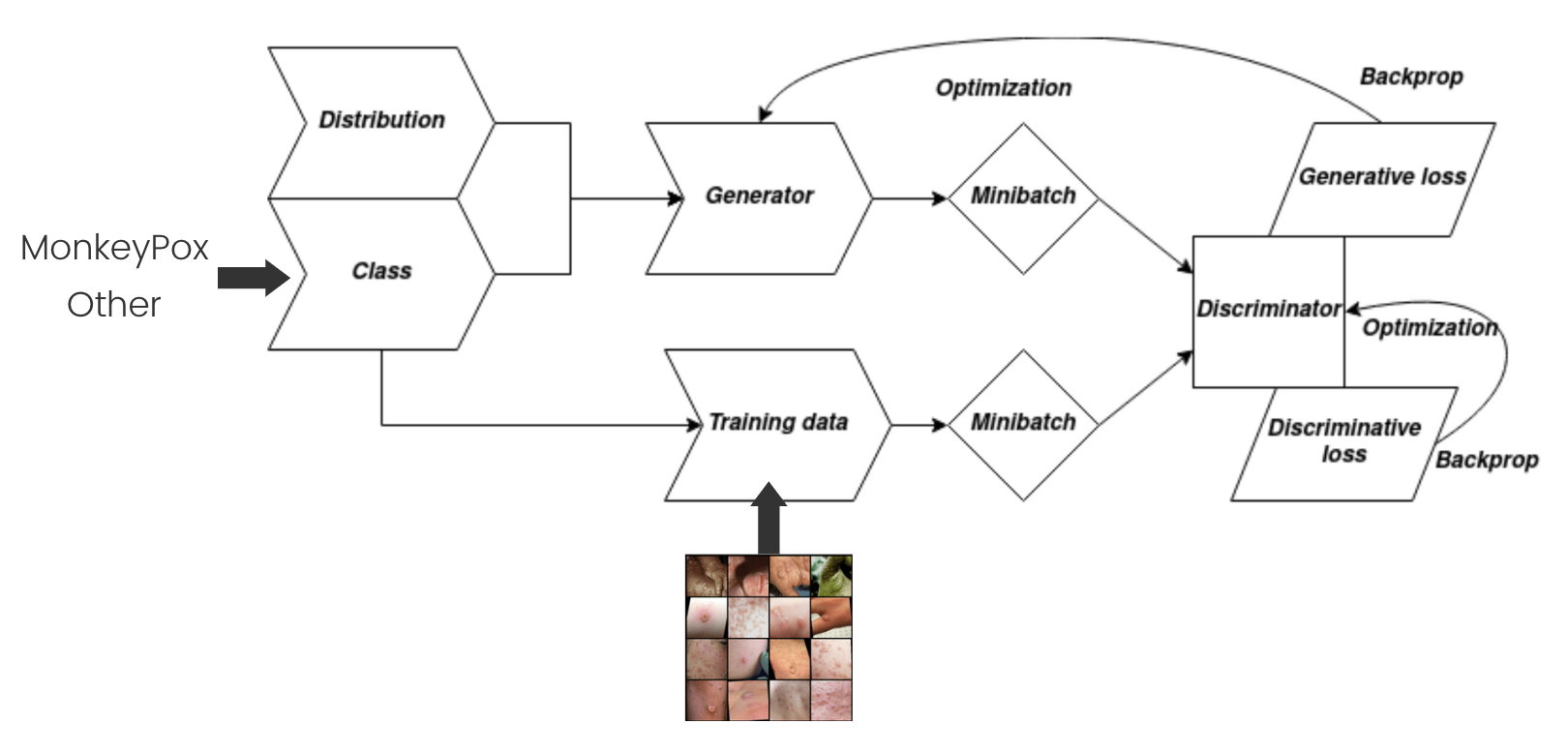
The generator receives a latent vector and a class label. An auxiliary classifier in the discriminator supports class-aware adversarial training.
03Explore optimizer behavior
I compared generator/discriminator learning-rate pairings with Adam, using a latent dimension of 100, batch size of 64, and 80 training epochs.
04Inspect samples and losses
I compared the generated 64×64 images with generator/discriminator loss curves. A higher generator learning rate relative to the discriminator gave favorable training behavior among the configurations I tested.
03 / RESULTS
What changed across training runs.
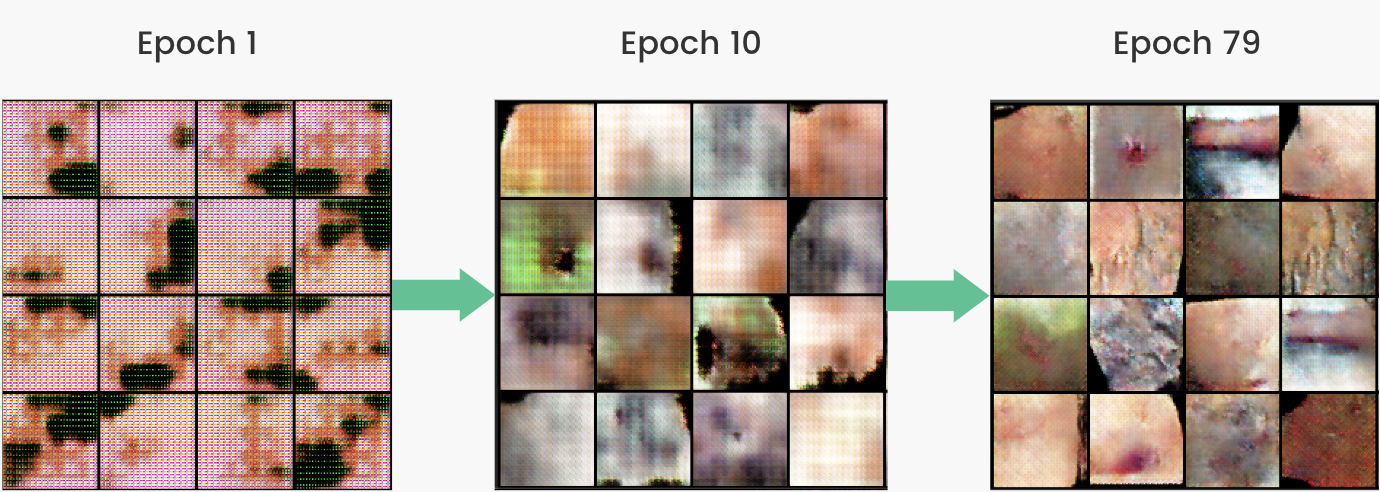
- The model produced class-conditioned 64×64 samples, with training progression shown above.
- Among the tested settings, the lowest discriminator loss occurred with a discriminator learning rate of 0.05 and a generator learning rate of 0.5.
- I evaluated the runs through generated samples and training losses; downstream classification performance remains a direction for further evaluation.
What I take from this work
This thesis gave me hands-on experience with conditional generation, adversarial optimization, and the challenges of learning from a small image dataset.
04 / DESIGN CHOICES
Working with scarce data and two optimizers.
Vary generator and discriminator rates separately
I tested learning-rate pairs for the two adversaries. The lowest discriminator loss in these runs occurred at 0.05 for the discriminator and 0.5 for the generator, illustrating how strongly their balance affected this experiment.
Keep original data separate from augmentation
The training pool grew to 3,192 variants, but it still came from 228 original images. That distinction shaped how I interpreted sample diversity and the limits of the experiment.
Inspect progression across epochs
The image grids at epochs 1, 10, and 79 show the generator’s progression alongside the loss curves. Quantitative image-quality metrics and downstream classifier experiments would extend this qualitative evaluation.